


Azulejos and Arches: Capturing the Spirit of Seville
Written by Lucy Winters-Underwood, founder of Lucy Winterwood Interior Design Studio. Serving St Albans, Harpenden, Hertfordshire & North London.
Seville is more than just a city; it is a living museum where the air smells of orange blossoms and the walls tell stories of empires. For design lovers, Seville offers a masterclass in how to layer history, blending Islamic geometry with Christian grandeur and 21st-century innovation.
Whether you are looking for home décor inspiration or planning an architectural pilgrimage, here is a guide to the soul of Sevillian design.

Setas de Sevilla; panoramic walk on the world's largest wooden structure.
Seville’s aesthetic is defined by its "Mudejar" heart—a unique style born when Muslim craftsmen remained in Spain after the Christian Reconquista. This fusion created a look that is unmistakably Andalusian.
The Royal Alcázar is the crown jewel of Seville, a masterclass in Mudejar. It’s a labyrinth of palaces where you’ll find the quintessential elements of the city’s design DNA:
Artesonado Ceilings: Intricate, interlocking wooden ceilings that look like honeycombs.
Horseshoe Arches: Sweeping, elegant curves that frame views of hidden gardens.
Stucco Work: "Yesería" or carved plaster that covers walls in lace-like geometric patterns.

Royal Alcázar of Seville
The Giralda & Cathedral: Where Gothic Meets Almohad. Standing as the world’s largest Gothic cathedral, this site is a literal layer cake of history. The Giralda tower was originally a minaret; its brick latticework (sebka) remains a primary inspiration for modern Spanish exterior façades.

Catedral de Santa María de la Sede; the world's largest Gothic Cathedral
The 1920s Renaissance: Built for the 1929 Ibero-American Exposition, Plaza de España is a semi-circular masterpiece by Aníbal González is a "greatest hits" of Spanish style. It combines Art Deco with Neo-Mudejar elements, using millions of colourful tiles to create a visual narrative of Spain’s provinces.
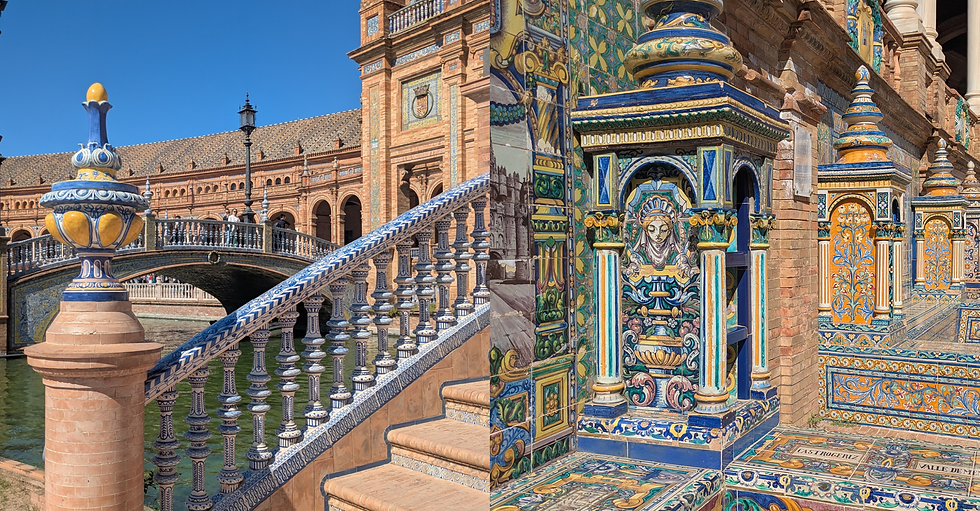
The Plaza de España in Seville, Spain: a breathtaking landmark,
located in Maria Luisa Park
Interior Design, bringing Seville into the home. Sevillian interiors are designed for the Mediterranean lifestyle: keeping cool in the blistering summer while maintaining a sense of "alegría" (joy).
Traditionally in Seville, the house is built around the Patio. This central courtyard serves as the home's lungs.
The Look: Marble columns, central fountains, and a forest of potted ferns and citrus trees.
The Takeaway: Even in modern apartments, the "indoor-outdoor" flow is essential. Use large mirrors and potted greenery to mimic the airy feel of a courtyard.
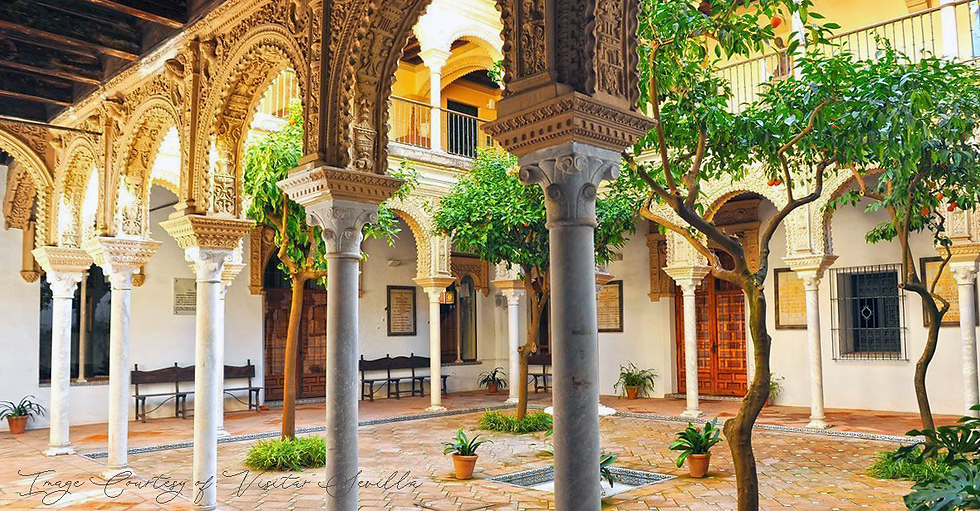
Traditional Andalusian courtyards, serving as tranquil, tiled, and plant-filled escapes from the summer heat.
You cannot speak of Seville without mentioning Azulejos (ceramic tiles). Historically produced in the Triana district, these tiles feature:
Geometric Mosaics: Early Islamic-inspired designs.
Majolica: Colourful Renaissance-style scenes often seen in kitchens and stairwells.
2026 Trend: Modern Sevillian designers are currently moving away from "perfect" factory tiles, favouring Zellige or handmade, irregular tiles that catch the light unevenly, adding a "lived-in" texture to bathrooms and backsplashes.

Traditional Andalusian courtyards, serving as tranquil, tiled, and plant-filled escapes from the summer heat.
Seville in 2026: The New Modernity. Seville isn't stuck in the past. Contemporary architecture like the Metropol Parasol (Las Setas) has shifted the city's skyline toward organic, fluid forms.
Current Interior Trends in Seville:
The Colour Palette. Forget the stark white minimalism of the North. Seville embraces a "warm minimalism":
Albero Yellow: The golden-ochre hue found in Seville’s bullring and historic plazas.
Cobalt Blue & Emerald Green: Traditional tile accents.
Terracotta: Used for floors (clay tiles) to keep spaces naturally cool.
Curved Forms: Echoing the arches of the Alcázar, 2026 furniture trends in Seville favour modular, "hugging" sofas and rounded alcoves.
Authentic Materials: A rejection of "fast furniture" in favour of heavy linens, artisanal wrought iron (rejería), and hand-carved wood.
Layered Lighting: Using warm, dimmable LEDs to highlight the texture of old stone walls or decorative plasterwork.


Comments